


Each year, late in the fourth quarter, the major market and economic thinktanks issue their forecasts for the new year to come. These forecasts grab headlines, provoke debates, and probably drive website clicks. For me, if I am honest, the forecasts stir skepticism.
I recently came across a great quote from Niels Bohr, a Nobel Prize-winning physicist, that summarizes my thoughts on these short-term forecasts. Bohr comically stated, “Prediction is very difficult, especially if it’s about the future.” While these forecasts can be informative, relying on them to make investment decisions is a flawed strategy. Here’s why we don’t base our investments on market predictions.
1.) Forecasts Are Often Wrong
As Bohr alluded to, making accurate predictions is challenging, to say the least. This is especially true with financial markets which are influenced by countless variables, many of which are unpredictable. Unexpected geopolitical events, technological breakthroughs, and consumer behavior shifts are just a few of items that can disrupt even the most carefully calculated predictions.
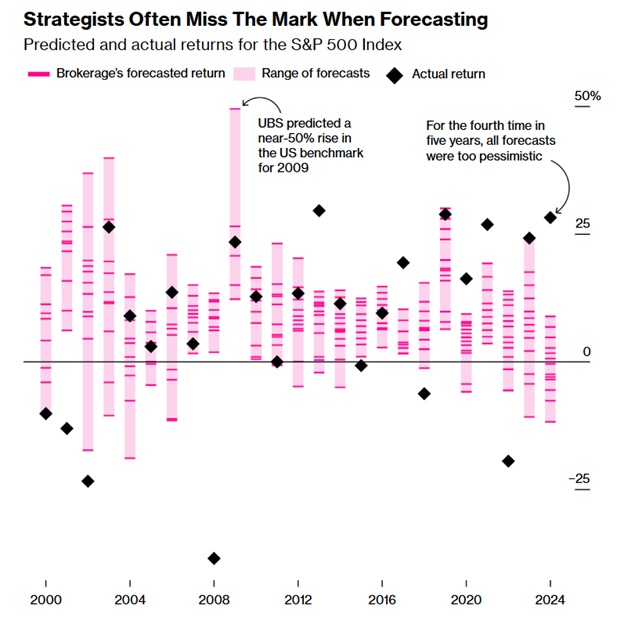
The chart below from Bloomberg shows Wall Street’s annual predictions for the S&P 500 since 2000 versus the actual returns. In many years, the market’s returns were outside the range of all compiled forecasts. History also shows the ones that have gotten it right cannot do so consistently. One might say everyone gets lucky occasionally. 😉
2.) Consider the Motivation for Issuing a Forecast
Market forecasts are inherently uncertain, sometimes misleading, and often wrong. Those making the predictions realize this. If that is the case, why do Wall Street firms issue these forecasts at all? In a word, marketing. Websites print these forecasts and TV pundits discuss them. Doing a quick search for 2025 market forecasts pulls up a plethora of articles and predictions from all the major market players. Sure, being right is nice, but getting noticed is usually the objective.
3.) Forecasts Create Noise, Not Clarity
Market forecasts typically focus on short-term trends, such as where the S&P 500 might be in 12 months or whether a recession will occur this year. However, investing is a long-term endeavor. The constant stream of market predictions can distract investors from their long-term goals. Over decades, markets have historically delivered positive returns despite short-term volatility. Reacting to short-term forecasts can lead to poor timing decisions, unnecessary portfolio adjustments, and second-guessing, which can undermine a sound investment strategy.
4.) Behavioral Pitfalls
Forecast-driven investing invites emotional and psychological pitfalls that can derail even the most carefully crafted financial plans. When investors rely on market forecasts, they often fall victim to emotional decision-making. Fear of missing out (FOMO) or panic during downturns can lead to buying high and selling low. Strategies centered around forecasts tend to amplify these behavioral biases, which can significantly harm portfolio performance.
Conclusion
Instead of basing investment decisions on predictions, we believe a disciplined, long-term approach focused on your goals is a far more effective method to investing. Principles such as diversification and asset allocation are a time-tested strategy proven to be more reliable than market predictions.
So, what should you do about those annual market forecasts? Our advice: remain disciplined and stick to your plan.
Happy New Year, and here’s to a great 2025!