


The Federal Reserve has been one of, if not the biggest, topic in financial markets news over the last few years. Interest rates and expectations of where they might be in the future always seem to play a primary role in the direction of financial markets.
But many individuals may not know exactly what role the Federal Reserve plays in the economy. With so much recent discussion in the news regarding interest rates and the Federal Reserve, we thought it might be helpful to provide a brief synopsis of what the central bank actually does.
The Federal Reserve, often referred to as “the Fed,” is the country’s central bank. It was founded by Congress in 1913 to provide the nation with a safer, more flexible, and more stable monetary and financial system. Prior to its creation, the U.S. economy was plagued by frequent episodes of panic, bank failures, and limited credit.
A Decentralized Central Bank
The Federal Reserve System consists of 12 independent banks that operate under the supervision of a federally appointed Board of Governors in Washington, D.C. Each of these banks works within a specific district, as shown.
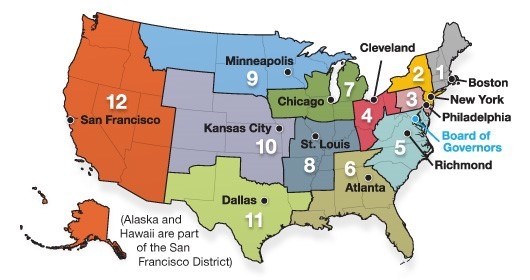
The Fed has four main roles in the U.S. economy.
Economy Watch
The Fed has what is often referred to as a “dual mandate,” which includes maintaining maximum employment and stable prices. The Act establishing the Federal Reserve actually mentions a third mandate, that of maintaining moderate, long-term interest rates. However, it is accepted that getting the first two mandates right will lead to accomplishing the third.
It’s important to remember that the Fed cannot directly control employment, inflation, or long-term interest rates. Rather, it uses a number of tools at its disposal to influence the availability and cost of money and credit. This, in turn, influences the willingness of consumers and businesses to spend money on goods and services.
For example, if the Fed maneuvers short-term interest rates lower, borrowing money becomes less expensive, and people may be motivated to spend. Consumer spending may stimulate economic growth, which may cause companies to produce more products and potentially increase employment. When short-term rates are low, the Fed closely monitors economic activity to watch for signs of rising prices.
On the other hand, if the Fed pushes short-term rates higher, borrowing money becomes more expensive, and people may be less motivated to spend. This may, in turn, slow economic growth and cause companies to decrease employment. When short-term rates are high, the Fed must watch for signs of a decline in overall price levels.
We currently find ourselves in a higher interest rate environment, relative to recent history, with the Fed widely expected to begin cutting rates in September.
Supervise and Regulate
The Fed also establishes and enforces the regulations that banks, savings and loans, and credit unions must follow. It works with other federal and state agencies to ensure these financial institutions are financially sound and consumers are receiving fair and equitable treatment. When an organization is found to have problems, the Fed uses its authority to have the organization correct the problems.
Financial System
The Fed maintains the stability of the financial system by providing payment services. In times of financial strain, the Fed is authorized to step in as a lender of last resort, providing liquidity to an individual bank or the entire banking system. For example, the Fed may step in and offer to buy the government bonds owned by a particular bank. By doing so, the Fed provides the bank with money that it can use for its own purposes. We saw this in action in 2007-2008 during the Great Financial Crisis and, to a lesser extent, during the mini banking crisis in the spring of 2023.
Banker for Banks, U.S. Government
Finally, the Fed provides financial services to banks and other depository institutions as well as to the U.S. government directly. For banks, savings and loans, and credit unions, it maintains accounts and provides various payment services, including collecting checks, electronically transferring funds, distributing new money, and receiving and destroying old, worn-out money. For the federal government, the Fed pays Treasury checks, processes electronic payments, and issues, transfers, and redeems U.S. government securities.
Each day, the Fed is behind the scenes supporting the economy and providing services to the U.S. financial system. And while the Fed’s duties are many and varied, its focus is to maintain confidence in banking institutions.
For more information about the Fed and interest rates, check out the episodes from our podcast, The Benchmark, titled “Interest rates and why they matter” and “Fed cuts and bonds.”