


AI Can Generate Answers. Building a Financial Life Still Requires Judgment.
Artificial intelligence (AI) is changing almost every profession, including financial planning and wealth management. AI can process information quickly, analyze large amounts of data, and identify patterns that might otherwise take hours to uncover. Many financial professionals have adopted AI because it helps structure technical work, leaving more room for the part of the profession that often carries the most weight.
What AI cannot do is understand the personal, emotional, and family factors that drive many of life's most important financial decisions.
Many important financial decisions are not determined by finding a better spreadsheet formula or a more efficient investment screen. They are driven by decisions made during periods of uncertainty, market volatility, career transitions, retirement, business succession, health challenges, and family change.
That is where experienced advice, judgment, and accountability remain essential.
How Is AI Affecting Financial Planning and Wealth Management?
As with most industries, AI has become part of how many financial advisors do their work. AI can help draft research, summarize information, model financial scenarios, identify portfolio trends, and surface questions worth exploring.
Many financial professionals have adopted AI because it can improve efficiency and help organize technical work. That allows more time to focus on what often matters most: helping clients make informed decisions about their financial lives.
However, processing information and analyzing data more quickly is not the same as knowing how and when to act on it. It is not the same as understanding a person's values, priorities, risk tolerance, family dynamics, or long-term goals.
Research supports that distinction. Morningstar's "Mind the Gap" study found that over the decade ended December 2024, the average dollar invested in U.S. mutual funds earned approximately 1.2 percentage points less annually than the funds themselves returned. Much of that gap occurred because investors tended to buy after markets had risen and sell after markets had declined.¹
This wasn't necessarily a knowledge problem. It was often a behavioral problem. Many investors had access to the same information. One factor that influenced investor experiences was how they responded emotionally when markets became uncomfortable.
An AI chatbot might explain why selling during a market decline can be harmful to long-term results. What it may struggle to do is help you navigate the fear, uncertainty, and anxiety that often accompany those moments. A trusted advisor who understands your goals and history can provide perspective when emotions threaten to drive decisions.
Financial Planning Is Rarely a Math Problem
Many of the most important financial decisions do not have a mathematically perfect answer. Here are a few examples that have come up in meetings in the last few weeks:
Should you retire this year or continue working another two years?
How much can you comfortably spend in retirement without jeopardizing long-term goals?
Does it make sense to gift assets to children today or pass wealth through your estate later?
What is the most tax-efficient way to support charitable causes you care about?
Should charitable giving come from cash, appreciated investments, a donor-advised fund, or qualified charitable distributions?
These are rarely investment questions. They are personal decision-making questions. They require context, priorities, judgment, and an understanding of tradeoffs. In our experience, clients rarely call because they need a stock recommendation. They call because they're trying to decide whether to retire, help an aging parent, sell a business, support a child, make a large charitable gift, or navigate a market decline. Those decisions rarely fit neatly into an algorithm.
AI can help organize information. A trusted advisor helps evaluate those tradeoffs and make decisions that align with your goals, values, and circumstances.
What Is a Financial Advisor Worth?
Research has consistently suggested that the primary value of a financial advisor is not stock selection or market timing. Vanguard's Advisor's Alpha framework has estimated that certain advisor practices may contribute measurable value over time, with a significant portion attributed to behavioral coaching and helping investors avoid costly mistakes.²
For the last 13 years, Russell Investments’ Value of an Advisor study has also sought to estimate the potential value associated with financial advice. In 2026, Russell Investments estimated that financial advice may provide measurable value through several planning and behavioral coaching activities, though individual results will vary.3
Similarly, the 2026 Employee Benefit Research Institute (EBRI) Retirement Confidence Survey found that 83% of workers who had access to a financial advisor felt confident about their retirement prospects compared to 53% of workers without access to professional guidance.4
It is important to view these findings appropriately. These studies measure population averages, not guarantees. No advisor can promise better returns or specific outcomes. The more meaningful takeaway is where the value appears to come from. It comes from decision-making. It comes from planning. It comes from helping people make thoughtful choices during periods of uncertainty.
Do People Trust AI or Human Advisors for Financial Decisions?
Survey research suggests many people still prefer having a human involved in major financial decisions. According to Northwestern Mutual's 2025 Planning & Progress Study, 53% of Americans said they would trust a human financial professional to help build a personalized financial strategy, while only 15% felt comfortable relying on AI alone.⁶
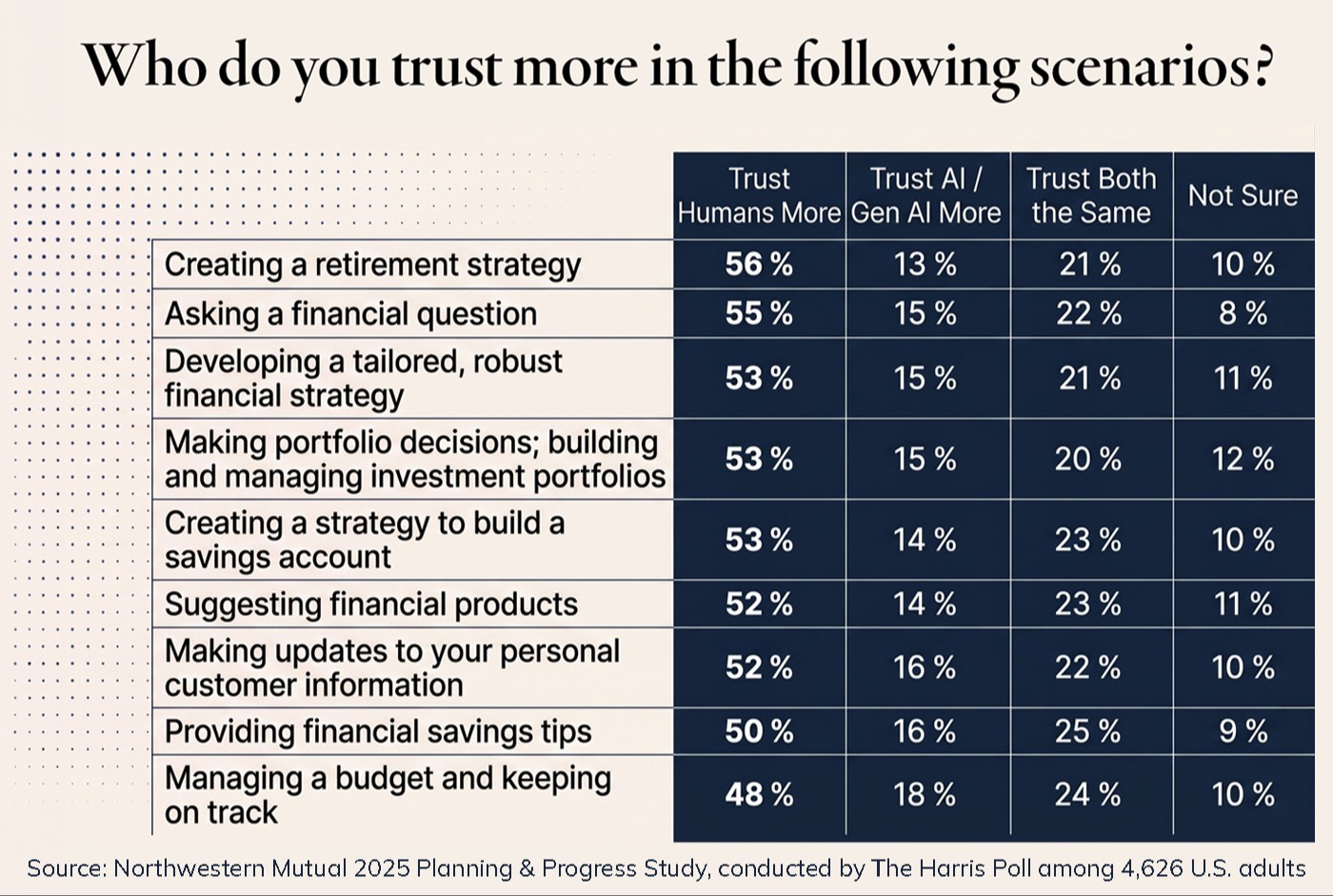
The reason is understandable. Financial planning is rarely just about money. It is often about freedom, family, security, purpose, legacy, and confidence in the future. Those conversations involve emotions and personal goals that extend beyond numbers on a spreadsheet.
Interestingly, the same research suggests that younger generations increasingly prefer working with financial professionals who thoughtfully incorporate AI into their process.⁶
That future does not appear to be a choice between people and technology. Instead, it appears to be about combining the strengths of both.
What Human Judgment Looks Like in Financial Planning
For many families, the greatest value of a financial advisor is not selecting an investment. It is helping coordinate decisions across every area of their financial life. A financial advisor may help evaluate:
Retirement timing decisions
Retirement income planning strategies
Social Security claiming options
Tax-efficient withdrawal strategies
Charitable giving opportunities
Estate planning considerations
Long-term care planning needs
Business succession decisions
Risk management and insurance planning
Family wealth transfer strategies
These conversations require understanding the people involved, not simply the numbers involved. For example, two families with identical investment portfolios may require completely different financial plans because their goals, relationships, health concerns, spending habits, and values differ.
The answers often depend on understanding a family's history and priorities. AI can provide information. Human judgment helps determine what that information means in the context of your life.
Should Financial Advisors Use AI?
In our view, yes. Clients should expect their financial advisor to utilize the best available tools, just as they would expect from a physician, engineer, or attorney. When used responsibly, AI can help advisors analyze information more efficiently, evaluate planning scenarios more quickly, and spend less time on administrative tasks.
The goal should not be replacing relationships with technology. The goal should be using technology to strengthen those relationships.
At BCS Wealth Management, we believe technology should enhance the planning process, not replace it. We embrace tools that help us analyze information more efficiently and serve clients more proactively. But the foundation of our work remains the same: helping clients make thoughtful decisions about retirement, taxes, investments, family, and legacy.
AI will almost certainly become a standard tool within the financial planning profession, much like financial planning software, portfolio analytics, and tax planning tools before it. That's a positive development for clients. When used thoughtfully, technology can improve access to information and help make the planning process more efficient.
But financial planning has never been solely about information. It is about helping people make important decisions in the face of uncertainty. As access to information becomes increasingly universal, the differentiator is often how that information is applied within the context of a person’s goals, circumstances and long-term plan.
Frequently Asked Questions
Can AI Replace a Financial Advisor?
AI can assist with technical and informational work such as research, data analysis, and financial modeling. However, it is not a replacement for personalized financial planning, behavioral coaching, accountability, and judgment. Most people still prefer human guidance when making significant financial decisions.
What Are the Limitations of AI in Financial Planning?
AI can process information rapidly, but it may struggle to understand a person's complete financial picture, values, family dynamics, and emotional responses to major life events. Financial planning often requires judgment, context, and experience that extend beyond data analysis.
Should My Financial Advisor Be Using AI?
Many clients benefit when their advisor responsibly incorporates technology into their process. AI can improve efficiency, streamline research, and enhance planning analysis, allowing advisors to spend more time focused on client relationships and strategic guidance.
How Can AI Help With Retirement Planning?
AI can assist with scenario modeling, retirement projections, data organization, and portfolio analysis. However, retirement planning also involves important personal decisions regarding income needs, spending priorities, healthcare costs, taxes, and family goals.
What Is the Difference Between AI-Generated Financial Advice and Personalized Financial Planning?
AI-generated information is generally based on patterns, algorithms, and available data. Personalized financial planning incorporates an individual's goals, values, circumstances, and evolving life situation. Effective planning combines information with human judgment.
Why Do Investors Make Emotional Financial Decisions?
Research has shown that investors often make decisions based on fear, greed, uncertainty, or overconfidence. These emotional reactions can result in buying after markets rise and selling after markets decline. Behavioral coaching can help investors stay focused on long-term goals.
Does Working With a Financial Advisor Improve Retirement Confidence?
According to the 2026 EBRI Retirement Confidence Survey, workers who had access to a financial advisor reported significantly higher levels of retirement confidence than those who did not. While confidence does not guarantee outcomes, professional guidance may help individuals feel more prepared and informed.
Sources:
1. Morningstar.com, November 7, 2025. Mutual funds are sold only by prospectus. Please consider the charges, risks, expenses, and investment objectives carefully before investing. A prospectus containing this and other information about the investment company can be obtained from your financial professional. Read it carefully before you invest or send money.
2. Vanguard.com, 2026.
https://advisors.vanguard.com/behavioral-coaching
3. RussellInvestments.com, 2026.
4. EBRI.org, 2026.
https://www.ebri.org/retirement/retirement-confidence-survey
5. Vanguard.com, February 24, 2025.
6. NorthwesternMutual.com, August 5, 2025.